
October 13, 2007

October 12, 2007
Lewis Conference (Day 3)
Day 3 of the conference began with an animated talk by Alan Hájek on whether formal methods are a boon or bane for philosophy. He also discussed whether we should be doing traditional epistemology or Baysian epistemology. He argued both sides of both issues, and then painted Lewis' intellectual history as a synthesis of the two sides of these two disputes. It was quite a treat.
Great talks were also given by Ulrich Meyer, Vladan Djordjevic, and Rohit Parikh.
Photos to come, but a small sample appear over at Lemmings.
October 04, 2007
Lewis Conference (Day 2)
 The talks today were on the semantics for conditionals. John Cantwell proposed a branching-time framework that aimed to unify our understanding of indicative and subjunctive conditionals. The variation in truth-value of corresponding indicative and subjunctive "Oswald sentences" is, on John's view, to be explained without positing a plurality of conditionals. The job can be done by tense and our understanding of open futures.
Hannes Leitgeb offered a probabilistic semantics for subjunctive conditionals. His very precise proposal (which I won't go into here) is a version of the thought that subjunctives are true just in case the consequent is sufficiently likely (in some objective sense) given the antecedent. By default Hannes rejects the strong and weak centering assumptions---respectively,
(A & B) --> (A []--> B), and
(A []--> B) --> (A --> B)
What this means is that, unlike the standard semantics, we get the desirable outcome that the truth of A and B is not sufficient to imply a counterfactual dependence between A and B, and that the truth of A and ~B is not sufficient to undermine a counterfactual dependence between A and B. The actual world can be one of the exceptional worlds where what does occur is not highly likely to occur (and where what is highly likely to occur does not occur).
Hannes replaces the centering assumptions with weaker centering-like assumptions---viz.,
(T []--> (A & B)) --> (A []--> B), and
(A []--> B) --> (T []--> (A --> B))
I believe T is meant to be a tautology, and so, the following rough paraphrase can be given: the truth of A & B does entail A []--> B, when A & B is sufficiently likely on its own, and the truth of A & ~B entails the negation of A []--> B, when A & ~B is sufficiently likely on its own. Perhaps we can put it in something like Lewisian terms. The stronger of the two says that no world is as close to the actual world as are the very likely worlds; and the weaker thesis is that no world is closer to the actual world than are the very likely worlds.


Photos:
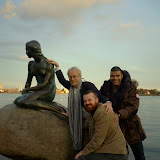
1. Statue
2. John Cantwell
3. Hannes Leitgeb
4. Niels Bohr Mansion
Lewis Conference (Day 1)
 Today began the 1st Synthese Annual Conference, Between Intuition and Logic: David Lewis and the Future of Formal Philosophy, which was hosted at the Honorary Niels Bohr Mansion in Copenhagen and organized by Johan van Benthem, Vincent Hendricks and John Symons.
John Collins started things off with his paper "Formal and Informal Models of Belief", in which he embraced a Lewisian theory of knowledge:
if S knows that X, then there is no uneliminated possibility that is very close to actuality and in which X is false.
 He argued, among other things, that the threat of skepticism is not as ubiquitous as Vogel and Hawthorne suggest. The statistical information that n number of otherwise healthy people die of a heart attack is not enough to make the world in which i die of a heart attack very close to the actual world. That's because people don't just die of heart attacks if absolutely nothing is medically wrong with them. Since the actual world is not one where unbenownst to me there is something wrong with me, there is no very close world where I am one of the unlucky few to die in this way. So, my original ordinary knowledge claim about where I'll be tomorrow still stands. Of course, if it turns out that unbenownst to me and my doctors there is something medical wrong with my heart, then my ordinary knowledge claim falters.
 Allesandro Torza gave the most formal of the talks thus far, titled "How to Lewis a Kripke-Hintikka". He argued that BL (i.e., [quantifier] independence friendly modal logic) is more expressive than QML (quantified modal logic); there are modal notions (e.g., the notion of rigidity for general terms) that can be expressed by BL but not by QML. However, this portion of BL cannot be translated into counterpart theory, and so, there is reason to doubt that counterpart theory is adequate to model our modal intuitions.
Brit and I gave a version of our paper "Remarks on Counterpossibles", in which we motivate and defend a modified version of Daniel Nolan's impossible worlds account of counterpossible conditionals.

Laurie Paul argued that the trumping examples, which have forced Lewis to give up his old theory of causation (see Schaffer's famous paper) do not obviously show what they were intended to show. The thrust of the objection was that until we clarify what it is to "interrupt a causal process", it is unclear how to interpret the trumping examples. The military handbook tells us that a Major's orders trump the Sgt.'s orders, but how do we get from there to a case of *causal* trumping? Merlin's (and not Morgana's) spell is stipulated to be the consequential of the two spells. But how do we get from there to Merlin's, but not Morgana's, spell caused the outcome?


September 22, 2007
David Lewis Conference
 SYNTHESE ANNUAL CONFERENCE
Title / Between Logic and Intuition: David Lewis and the Future of Formal Methods in Philosophy
Synthese hosts its first annual conference at the Carlsberg Academy in Copenhagen, October 3- 5 , 2007. The conference is sponsored by PHIS - The Danish Research School in Philosophy, History of Ideas and History of Science and Springer.
Abstract / David Lewis is one of the most important figures in contemporary philosophy. His approach balances elegantly between the use of rigorous formal methods and sound philosophical intuitions. The benefit of such an approach is reflected in the substantial impact his philosophical insights have had not only in many core areas of philosophy, but also in neighboring disciplines ranging from computer science to game theory and linguistics. The interplay between logic and intuition to obtain results of both philosophical and interdisciplinary importance makes Lewis' work a prime example of formal philosophy. Lewis' work exemplifies the fruitful interplay between logic and intuition that is central to contemporary philosophy. This conference serves as a tribute to Lewis and as a venue for adressing questions concerning the relationship between logic and philosophical intuition.
This first Synthese Annual Conference is the venue for discussing the future of formal methods in philosophy.
Invited Speakers
John Collins, Alan Hájek, Hannes Leitgeb, Rohit Parikh and L.A. Paul
Speakers
Berit Brogaard and Joe Salerno, John Cantwell, Vladan Djordjevic, Ulrich Meyer, Neil Tennant
Program Committee and Conference Chairs
Johan van Benthem, Vincent F. Hendricks, John Symons (SYNTHESE) and Stig Andur Pedersen (PHIS)
Conference Manager
Pelle Guldborg Hansen
Registration
Please write conference manager Pelle Guldborg Hansen to register:
Department of Philosophy and Science Studies
Roskilde University, P6
P.O. Box 260
DK4000 Roskilde, Denmark
Phone: (+45) 4674 2540
Cell: (+45) 2334 2175
Fax: (+45) 4674 3012
Email: pgh@ruc.dk
A conference fee is to be paid cash upon final registration (Wednesday, October 3, 2007). The conference fee is 150,00 Danish kroner a day, thus participation for the entire duration of the conference (Thursday, October 3 – Saturday 5, 2004) is 450,00 Danish kroner. The conference fee covers the lunches with free beverages, conference booklet, tea and co¤ee during the breaks. NOTICE: Please remember exact amount. Deadline for registration Monday, October 1, 2007. If email is used include ‘SAC 2007’ in the subject entry. All questions pertaining to registration and accommodations should be directed to Pelle Guldborg Hansen.
Conference Website:
http://www.springer.com/west/home/philosophy?SGWID=4-40385-70-35761018-0
Subscribe to:
Posts (Atom)